The list of things it must never do
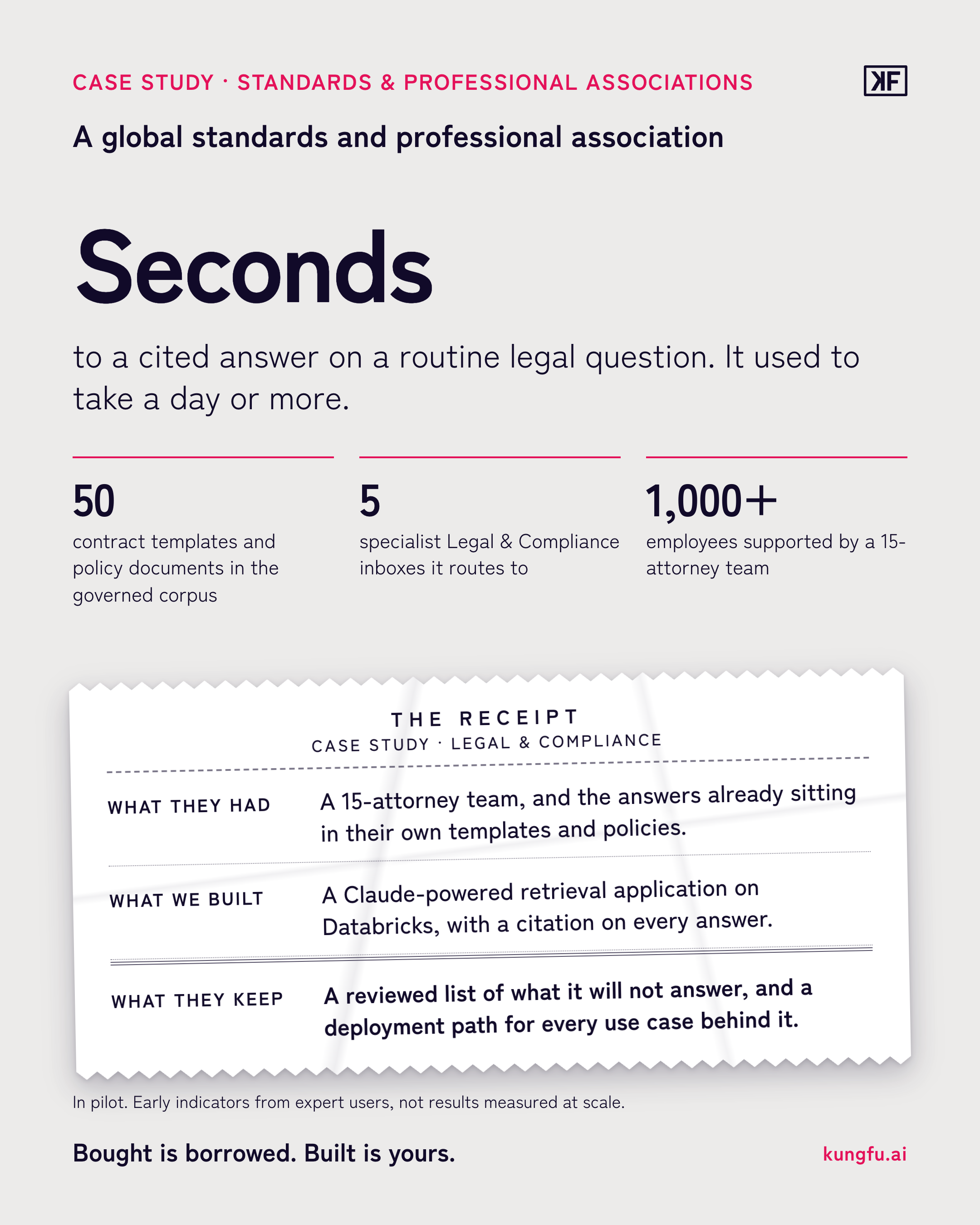
The most important requirement the Legal & Compliance team set for its AI assistant was a list of things it must never do.
It must never give legal advice. It must never answer a question that calls for an attorney's judgment. And it must never ask a user to take an answer on faith. The organization's General Counsel reviewed the guardrail definitions directly.
That list says a great deal about the team that wrote it. A Legal & Compliance group of about 20, including 15 attorneys, supports more than 1,000 employees at a global standards and professional association. Every day those employees email the same categories of questions: which contract template applies, what a given policy says, what needs to be signed before something can be shared. The organization executes more than 3,000 contracts a year, and contract templates drive much of that inbound volume.
The answers already existed, in documents employees could open themselves. The cost sat in the routing. An employee could wait a day or more for an answer to a template already contained, and a lean legal team spent its capacity on lookups instead of the skilled negotiation and advisory work that requires an attorney.
Choosing where to start
The assistant was one of several candidates. KUNGFU.AI supports the organization through an AI execution support program that moves a portfolio of use cases through a staged lifecycle, from idea to adoption. Legal & Compliance was evaluated against value, complexity, and stakeholder commitment, and led on all three.
It also carried a second requirement. This would be the first AI solution the organization deployed on Databricks, so the delivery pattern had to be reusable by every use case queued behind it. Identity, access, and architecture review were as much a part of the work as the model.
Building to the brief
The Legal & Compliance team defined what good looked like. Answers in plain language rather than legalese, short enough to read at a glance. A citation and a link to the source document on every substantive answer, so a user can verify rather than trust. Anything out of scope routed to the right specialist inbox: general legal intake, contract review, compliance, privacy, or trademark.
KUNGFU.AI built an agentic retrieval application over the organization's governed corpus of contract templates and policy documents, the source of truth for contract drafting. It cleared the organization's Enterprise Architecture review before any user saw it. The team tuned the configuration against observed performance rather than assumption. Temperature went from the default of 1 to 0, because when the answer is a policy, consistency matters more than variety.
The first version searched the full corpus on every prompt, greetings included. The application now classifies each question first and skips retrieval when none is needed, which cuts both cost and latency. A ten-turn context window with history-aware query rewriting lets a user refer back to a document retrieved earlier, and when a question is ambiguous the application asks for context before it routes.
Measured, not assumed
Alongside the application, KUNGFU.AI and the client built a curated golden dataset of questions and correct answers and an offline evaluation pipeline in MLflow that scores responses on grounding in source documents, retrieval accuracy, and routing accuracy. Every change to the model, the prompt, or the corpus is tested against that baseline.
The proof of concept reached Legal & Compliance subject matter experts in July 2026. Structured feedback sessions through August fed directly into guardrail definitions and response formatting. In September the pilot opened to the organization's chief negotiators, the highest-frequency requesters and the users most likely to surface real edge cases, with a live dashboard calculating quality metrics as their feedback arrives.
Measured response time today is 4 to 6 seconds for questions that need no document retrieval and 10 to 12 seconds when a document scan is required. The target at release is under 5 seconds. Against a baseline of a day or more, both numbers change what an employee does next.
What changes
The application is in pilot, so these are early indicators from a small group of expert users, not results measured at scale. Routine questions that could wait a day or more now return a cited answer in seconds. Template and policy lookups no longer need an attorney in the loop. The same question produces the same cited answer, whichever attorney would otherwise have fielded it. And the organization has a proven platform, governance, and deployment path for the use cases behind this one.
Broader rollout to employees is targeted for the end of October 2026, and the client and KUNGFU.AI will quantify impact once it is live.
What will make the assistant useful to 1,000 employees is the same thing its legal team asked for first: a clear, reviewed list of what it will not answer.