What Handwashing Can Teach Health Systems About AI
In 1847, Ignaz Semmelweis asked doctors at a Vienna maternity clinic to wash their hands in chlorine before examining patients. Within two months, deaths on the ward fell from roughly 18% to about 2%. His colleagues still resisted the practice for decades. The evidence was there. It simply didn't fit how they understood disease.
In a new piece for Fast Company, KUNGFU.AI Co-founder & CEO Stephen Straus and Senior AI Strategist Ben Szuhaj, co-authors of Wayfinding, argue that healthcare's AI problem looks a lot like that. The barrier isn't a lack of tools or interest. It's the wrong mental model.
Patients and clinicians aren't waiting
The demand is already here. Roughly a third of Americans have used AI for health information, and about one in four did so in the past month. The heaviest users are younger people and people who may not have easy access to a doctor, such as the uninsured.
Clinicians are moving too, mostly on their own. OpenEvidence, a free clinical reference, grew from about 3 million physician consultations a month to about 18 million a month by December 2025.
Health systems, meanwhile, are struggling to turn that energy into results, and they aren't alone. Across industries, 88% of AI pilots never reach production, and a recent National Bureau of Economic Research working paper found that only about one in 10 companies report productivity gains from AI over the past three years.
Everything on that list is for sale
Notice what patients and doctors are reaching for: a chatbot, a free reference tool, an app anyone can download. Those tools help individuals, and that matters. But every health system in the country has access to the same ones. A tool your competitor can adopt on Monday is not a strategy. Adoption is not the same thing as advantage.
What a health system can't buy is what it already has. Years of imaging and outcomes data drawn from its own patient population. The judgment of its clinicians. Workflows, referral networks, and patient trust built over decades. These assets are already in the building. The hard part is making them useful, safely, in production.
That is where the mental model gets in the way.
AI is not traditional software
Stephen and Ben lay out the core differences. Traditional software is written. AI is trained. Software is deterministic: if this, then that. AI is probabilistic and depends on its data. Software gets built in a line. AI gets built in loops, and most of the real work happens before anything that looks like a product exists.
Manage AI like software and you end up specifying the answer before checking whether your data can produce it. In healthcare, that risk is concrete. A model trained on images from several hospitals can learn to recognize the scanner instead of the condition, then fail at the first hospital it hasn't seen. The article points to a widely used sepsis model that, when an outside team evaluated it, missed two of every three cases.
An original data asset paired with a brittle model is not an advantage. It is a liability with a good story attached.
Wayfinding: moving forward without a map
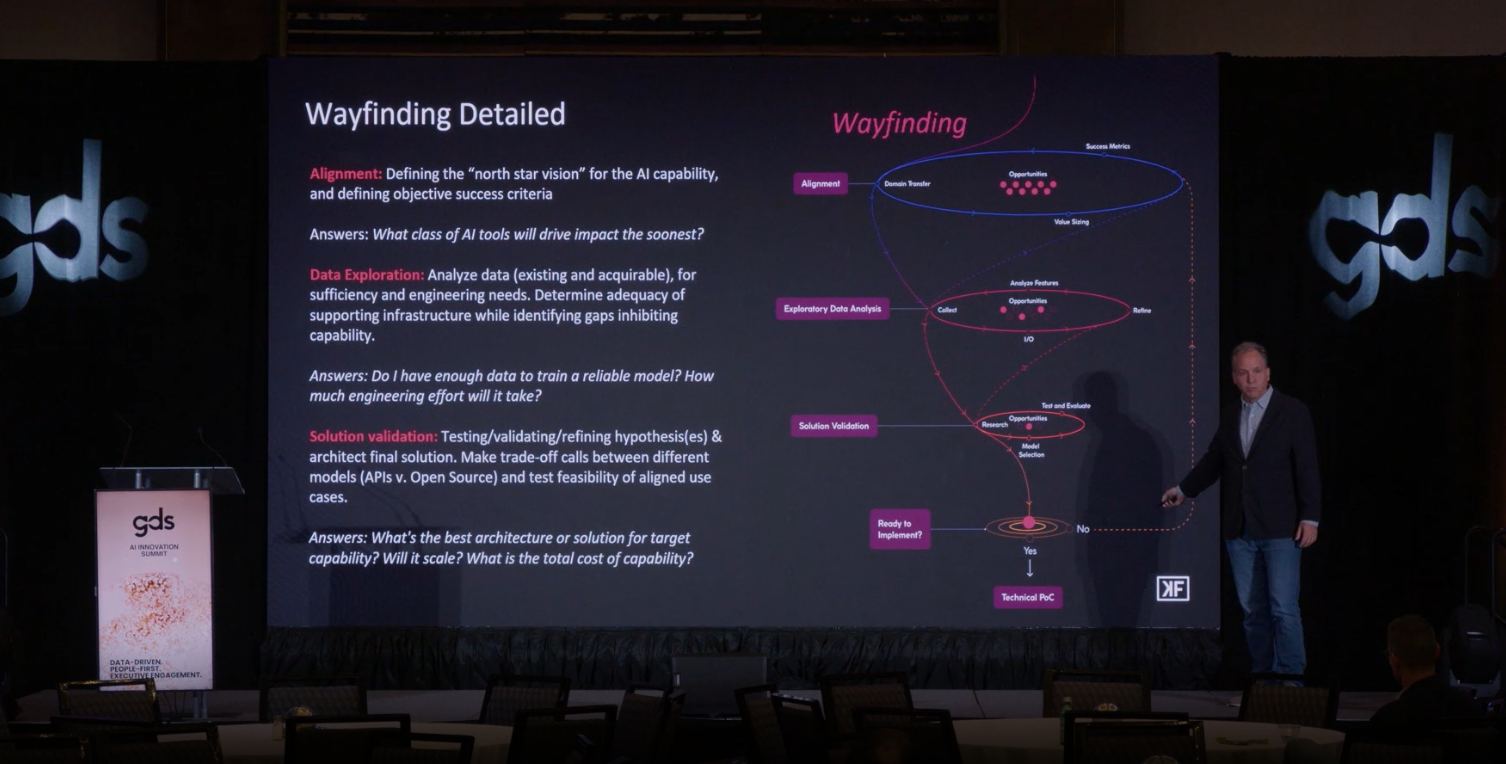
Following directions assumes someone has made the trip before. With AI, nobody knows the exact destination or route, so you course-correct as you go. That is the idea behind wayfinding, the approach at the center of the book. It works on two levels.
As a leadership philosophy, it asks for curiosity, humility, and the psychological safety that lets teams admit what they don't know, so learning speeds up instead of hiding. As a technical methodology, it is an adjunct to agile built for how AI actually gets made. Teams spend real time up front aligning on the problem and testing whether the data can support it, and they treat stepping back a phase as a normal move rather than a failure.
The article distills three things any healthcare leader can act on now.
- Spend more time choosing the problem
The best medical AI tends to do something no human can, and it starts with a specific, meaningful question. The authors suggest a simple prompt: how would the world be better if we could do X? A good test to pair with it: if a competitor could buy the same result off the shelf, it probably isn't the problem to build for.
- Make sure the data can answer the question
A model is only as good as its training data, and it will exploit any shortcut the data allows. Assembling and checking data often takes far longer than training. The article compares it to cooking: choosing the recipe is quick, but sourcing the ingredients is where the time goes, so confirm you can get them before you heat the pan.
- Rearchitect the work around people
Technology alone won't fix healthcare. Models have to create value inside complex systems made mostly of people, which means designing human-machine teams deliberately. The authors cite a study in a Lancet journal: after experienced endoscopists grew used to AI assistance, their detection rate without it fell from 28.4% to 22.4%, below where it started before they ever used the tool.
That finding matters beyond safety. Clinical expertise is one of the original assets a health system owns. A tool that erodes it trades a durable advantage for a short-term gain, no matter how accurate the model looks on paper.
The small change with the outsized effect
Handwashing didn't require new equipment. It required a different way of thinking about the work. AI in healthcare is in a similar spot. The tools are everywhere. What separates the systems that pull ahead will be a better mental model: start from what only they hold, prove the data can carry the question, design around the clinicians, and get it into production.
Read the full article in Fast Company. For the complete approach, including how leaders can apply it across strategy, governance, and teams, pick up Wayfinding.