
AI via Fierce Humanism - Building Better than Good Enough
My opinion is that LLMs work great at a shallow level but absolutely need a human to guide them through deeper waters. Not because they can’t do what they’re prompted to do, but because it is so immensely difficult to truly describe a task in its entirety.
People amaze me every day. We move mountains and touch the stars. And yet every person there’s ever been will continuously and forever deeply underestimate how complex every little thing they do actually is. I’m talking about everyday moments like getting a spoon from a drawer without bumping into anything; seeing another car drifting in their lane and predicting what unlikely maneuver they might be gearing up for; or understanding how to comfort a child who’s living in a completely different world from the one you lived in at their age. These are all little moments that require coordination of dozens of different systems and ideas, all happening in real-time with barely a flicker of conscious thought. A career of trying to design software that could do the same has given me a real appreciation for just how much every single person does moment-to-moment.
I originally studied language learning and was particularly motivated to excavate its basic building blocks. I wanted to know the minimum necessary toolkit to learn your first language. The mystery is not solved, but I did learn that words are not even close to sufficient. Once you try to deconstruct it, language reveals itself to be incomprehensibly rich. It’s so much more than the structural components of word choice, grammar, tone, inflection, etc. Language exists in how it’s said, when it’s said, what is not said, who the speakers and listeners are, where the speaker is looking even. Language is a means to an end – communication. As fluent speakers, every one of us navigates this complexity nearly flawlessly hundreds or thousands of times per day.
I once saw an upsetting description of speech: “I’m going to use ~40 muscles in three seconds to precisely wobble the air near me in order to wobble the air near you so that two days from now you remember to buy milk while shopping.”
This brings us to the current moment in AI. LLMs, generative AI, agentic AI, and all sorts of terms are floating around promising to be the magic wand you’ve always needed. On the surface, they genuinely look like they either deliver on that promise or are mere months away. It’s incredible what you can do with Claude off the shelf; new reports are constantly detailing the mind-boggling amount of investment that corporations are putting into AI tools; and many programmers are wondering how soon they won’t need to write code at all. At the same time, there are equal numbers of reports about LLM-powered catastrophes (many funny, many not); of failures to realize return on corporate investment; and of costly system outages linking back to AI-generated code. The problem in making sense of these contrasting headlines is that both are true. Can LLMs automate your job or do they merely produce a torrent of AI slop? Yes.
My opinion is that LLMs work great at a shallow level but absolutely need a human to guide them through deeper waters. Not because they can’t do what they’re prompted to do, but because it is so immensely difficult to truly describe a task in its entirety. If you reduce a business process (often meaning: people) to numbers on a balance sheet then AI will appear to be a drop-in replacement with pure upside for the business. But this risks throwing the baby out with the bathwater. It will work often, but may fail subtly, frequently, and silently without the guidance of a person steeped in the true richness of the task. There is a path forward, but it will take more consideration and effort than the glitz of the latest Copilot superbowl commercial will have you believe.
The path forward lies in what I’m terming “fierce humanism”.
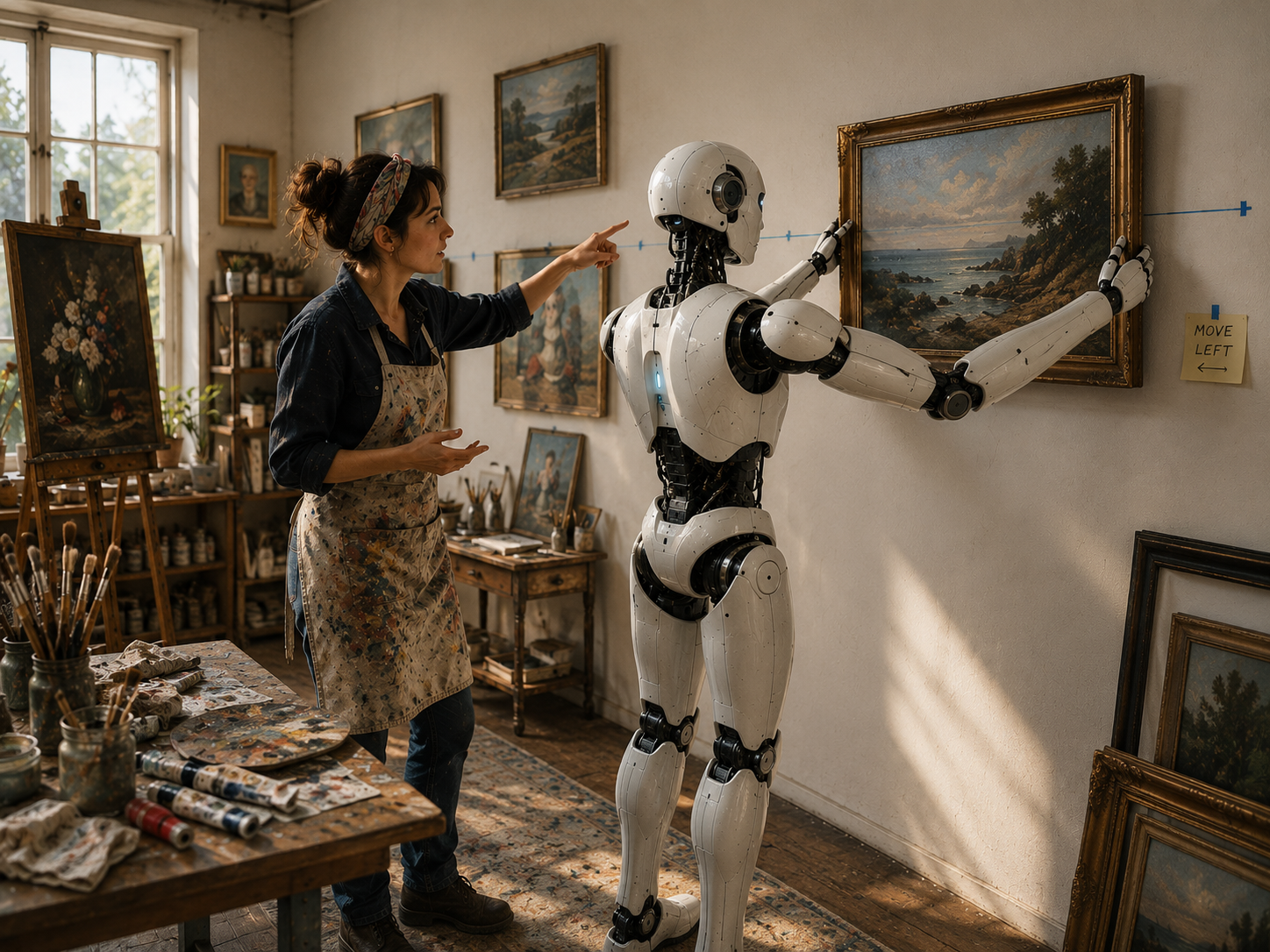
Fierce humanism is the way to honor the deep complexity of what your people do every day and raise them to new, collective heights using technology. At this exact moment it means fighting gravity, resisting the pull (that can so quickly become an orbit) of rationalizing the LLM’s output as “[probably] good enough”. Fierce humanism consists of doggedly uncovering and celebrating the endless nuance that it takes to do almost any specific task well. It pries open the critical door – allowing you to identify the best avenues for AI augmentation while preventing undetected loss of quality. It requires patience, persistence, curiosity, investment, and, frequently, ferocity. It means relentlessly pushing to envision how processes could be rebuilt rather than racing to a sufficient facsimile of the status quo. LLMs are an incredibly powerful and exciting technology that meaningfully define a new quality floor for just about any task out there. Don’t ask your customers to eat off your floor.
There’s also a very practical reason to embrace a more holistic approach to human-machine teaming. The more you put the latest GPT model at the steering wheel, the less differentiated you will be from anyone else doing the same. Your organization and your people do things in uniquely rich ways, creating uniquely rich data in the process. This is a very real, very important asset that I find continuously undervalued across organizations. No two companies are identical and by surrendering the pivotal role that proprietary data and processes play in articulating this, you are unknowingly risking surrender of what makes you unique and, therefore, valuable.
Embracing fierce humanism is a long journey, but it has an easy on-ramp. If you are looking to automate a task in your organization using AI, do a ride-along with the people who do it today. Roll up your sleeves and get into the details. It is unbelievable how much you will discover with a few questions and a lot of careful listening. If you then want to merge into the fast lane, try out an LLM-powered solution and precisely measure how well it does. Examine the cases where it failed. 99 times out of 100 you will discover that your people were doing more than you ever realized. And that’s cause for celebration.


