
The Four AI Mistakes Most Leaders Make
Every company already owns something its competitors can't buy. Most AI programs never touch it.
That's the thread running through a recent talk by Stephen Straus, Co-Founder and CEO of KUNGFU.AI and co-author of the forthcoming book Wayfinding. Most AI initiatives stall before production, and most organizations still aren't reporting real productivity gains. Stephen argues the cause isn't the technology. It's four mistakes leaders keep making in how they approach it.
Watch the full talk: The 4 Big Mistakes Leaders Make with AI
Mistake 1: Assuming AI is like software
Software is deterministic. Decades of process exist to manage things that behave the same way every time. AI is probabilistic, and that changes more than the engineering.
It changes the culture you need. When teams do new things for the first time, some of those things will fail. Cutting-edge work needs creative people, and creative people need to be able to say "I've never done this before" or "I failed" without being punished for it. Stephen points to Dr. Amy Edmondson's research on psychological safety as the foundation. Without it, you can't attract, retain, or enable the talent AI work demands.
Mistake 2: Assuming AI can be managed like software
Agile is excellent at telling you how to build something. It can't tell you what to build. Feed the wrong idea into a strong Agile process and you get a well-run project that never reaches production.
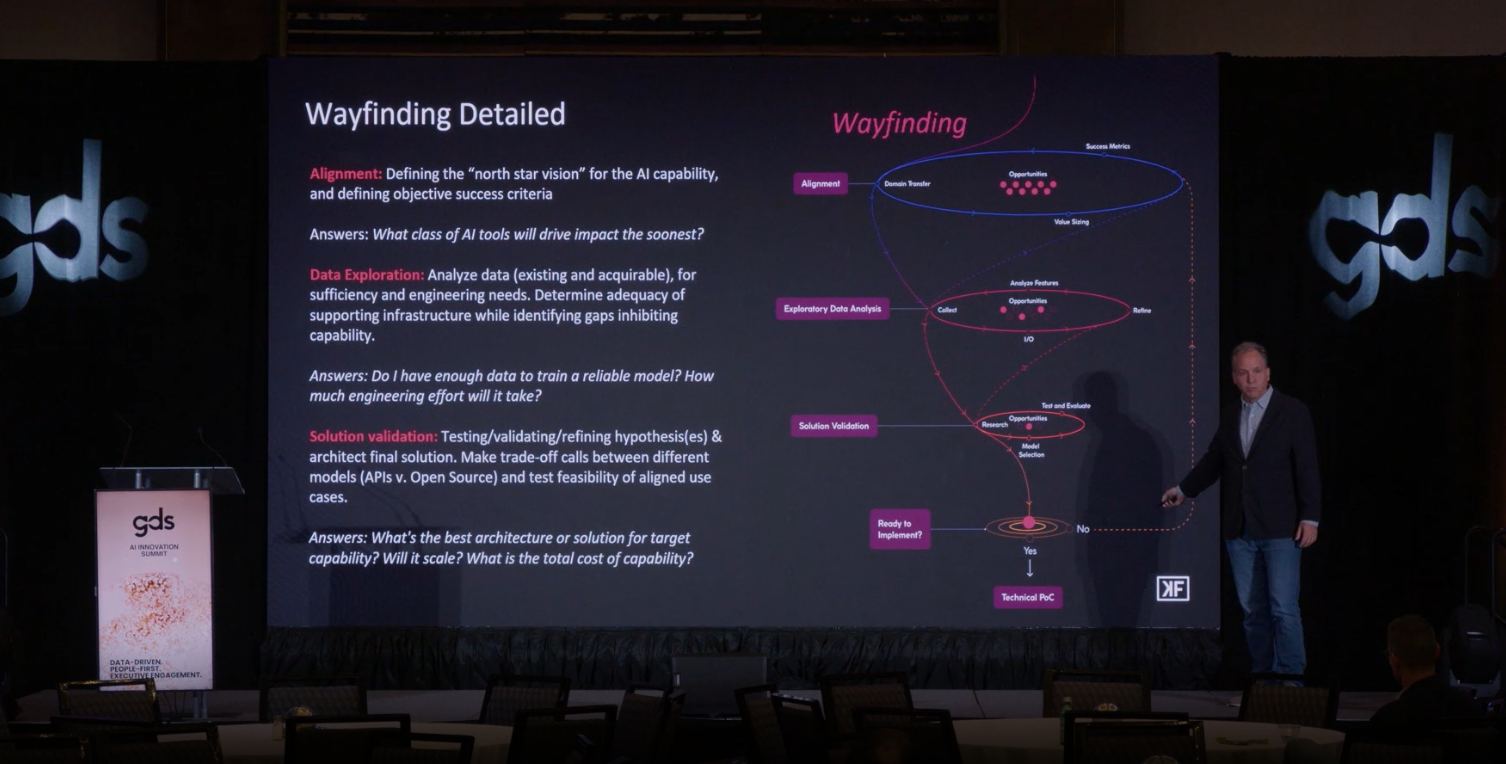
That's the gap Wayfinding fills. Navigating means you know the destination and need a route. Wayfinding means moving through deep uncertainty without fully knowing either. With AI, that's where every leader is.
The Wayfinding methodology is an adjunct to Agile built for AI's unique needs. It moves through four stages: alignment, data exploration, solution validation, and only then implementation. Teams iterate between the business objective, the data, and the model until they know a proof of concept can reach production before they start building it. Stephen's shorthand: go slow to go fast.
The methodology only works with the right people at the table. That means AI strategists who understand the business and the industry, data scientists who can read the data, and machine learning engineers who can judge feasibility and accuracy quickly.
Mistake 3: Conflating AI with LLMs
Generative and agentic AI get most of the attention, but they're one tool in a much larger box. Deep learning and other machine learning approaches have been around longer, are more mature, and are often more accurate for specific problems.
Stephen compares an LLM-only strategy to showing up at a construction site with a hammer and leaving the toolbox at home. You're missing tools, and everything starts to look like a nail.
Mistake 4: Automating the business you have today
Ask leaders how much AI will change their industry and most say "completely." Then they spend their AI budget automating the business as it stands. Stephen's comparison: being proud of agentifying your company today is like being proud of automating Blockbuster Video, when Netflix is just around the corner.
The LLMs everyone uses are available to everyone. Your competitor can buy the same stack on Monday and catch up by Friday. What they can't buy is your data.
Stephen's argument is that industries change through narrow, purpose-built models trained on proprietary data and aimed at a strategic fracture point. Find the AI-enabled business model that only your data makes possible. Then automate that future state, not today's.
What it looks like in production: Triumph Financial
Triumph Financial, a public company in Dallas, processes $18 billion in transactions at an average of about $500 each. They asked KUNGFU.AI to surface information that would help their people make better transaction decisions.
KUNGFU.AI told them that was the wrong engagement. The real asset was already in the building.
- A unique dataset. Triumph held decades of transaction data, complete with outcomes. Their competitors, like Triumph, took two to three days to return a decision.
- A custom model, applied. KUNGFU.AI built a narrow deep learning model on that data. It ran in parallel for six months without making decisions, then went into production with its confidence threshold raised gradually to manage risk. It now handles 70% of transactions automatically in nine seconds. Connected to a debit card, customers receive funds within 30 seconds. Triumph kept its 300-person team, who now focus on the cases the model isn't confident about, including fraud detection, and their findings feed back into the model.
- A new competitive advantage. Triumph changed the basis of competition in its industry to speed: funding in 30 seconds, 24/7, against competitors' days. Every transaction it wins adds data its competitors don't have, so the lead compounds.
Bought is borrowed. Built is yours.
The four mistakes share a root. Each one points AI at something anyone can buy: a familiar process, an enterprise license, a business that already exists. The way out starts with what only you have.
If a competitor can execute your AI strategy, it isn't your AI strategy.
Watch Stephen's full talk for the complete argument, including his Q&A on guardrails, team structure, and how long the Wayfinding process takes.
Wayfinding is available now- purchase the book here.
